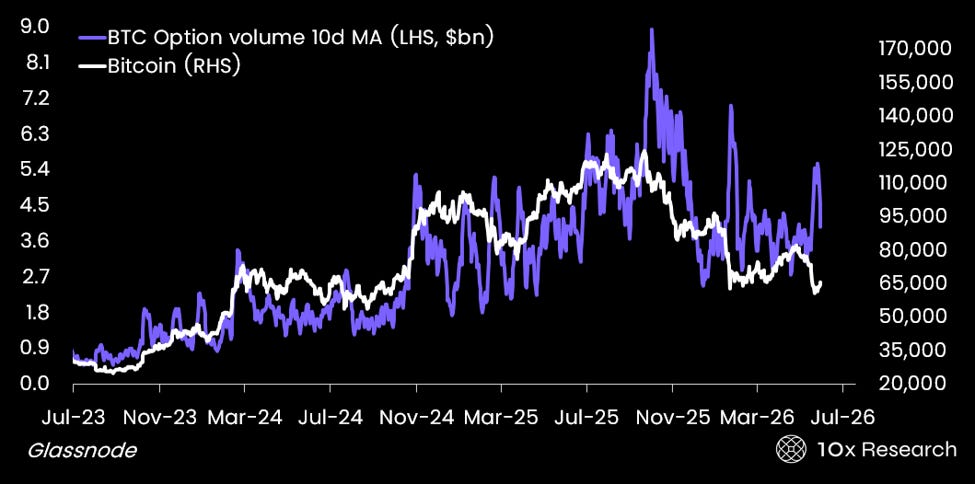

Bitcoin’s elevated volatility is structural, driven by information asymmetry between market participants and a marketing-heavy culture that financial regulators would rarely tolerate elsewhere. Many have tried to systematically harvest this volatility. Most have failed.
In our May 12 report, we estimated Bitcoin investors were leaving $7 billion in annual yield on the table. BlackRock has now responded with the Bitcoin Premium Income ETF (BITA), but compared to our strategy, BITA makes the opposite design choice at nearly every key decision point.
BlackRock Bitcoin Premium Income ETF is poorly constructed. In nearly every scenario, whether Bitcoin rises, trades sideways, or falls, investors are close to guaranteed either to underperform Bitcoin or generate poor absolute returns. This stands in stark contrast to the strategy we proposed in mid-May.
Three conditions determine when overwriting Bitcoin exposure generates yield worth capturing. When all three align, selling calls is the high-probability trade. When they don’t, the correct position is to do nothing and keep the upside open. Traders who write calls outside those conditions are not generating yield, they are giving away optionality at a discount. That is precisely what BITA does, every month, by mandate. Our framework is the alternative: selective, conditional, and structurally designed to act only when the odds are genuinely in your favor.
BTC Option volumes (LHS, $bn) vs. Bitcoin (RHS)