Crypto Fundamentals Remain Challenging 💥
Helping EVERYONE to make better crypto investment decisions.

... and based on Ethereum’s latest revenue numbers, the Ether price appears vastly overvalued.
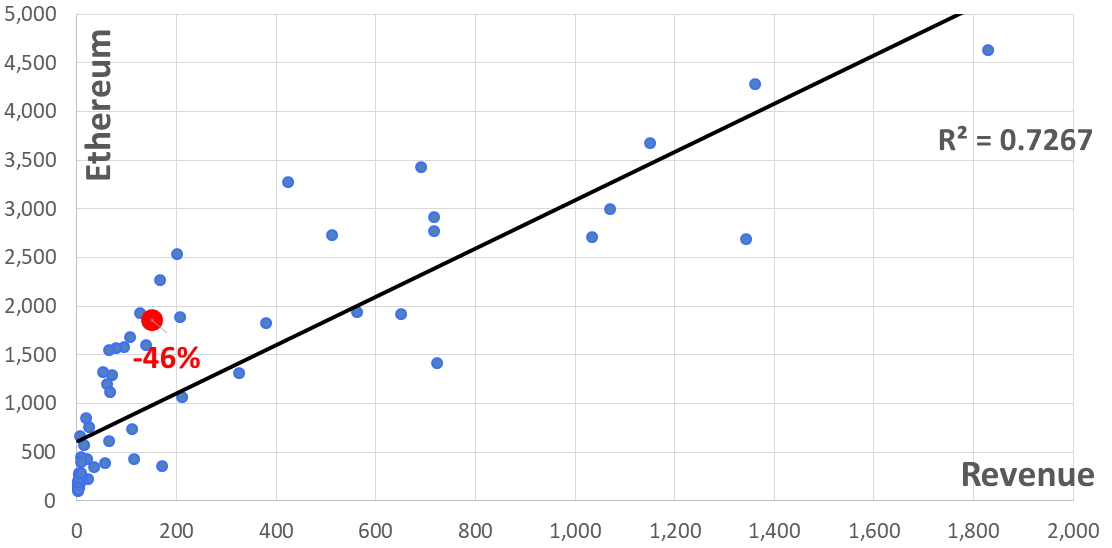
👇 1) Based on one quantitative approach, Ether’s fair value appears closer to $1,000 or -46% lower than current prices ($1,856). While we do not necessarily predict such a decline, there is a zero-cost way to position for this decline (zero-cost, but not zero-risk).
👇 2) Revenues are fees that accrue to the protocol, either to the token’s treasury or to the holders, while fees are paid by protocol users, except gas fees. Ethereum is averaging $178m in monthly revenues, compared to average monthly revenues in 2022 of $350m and $826m in 2021.
Chart: Ether price (LHS) vs. Monthly Revenue (RHS, billions)
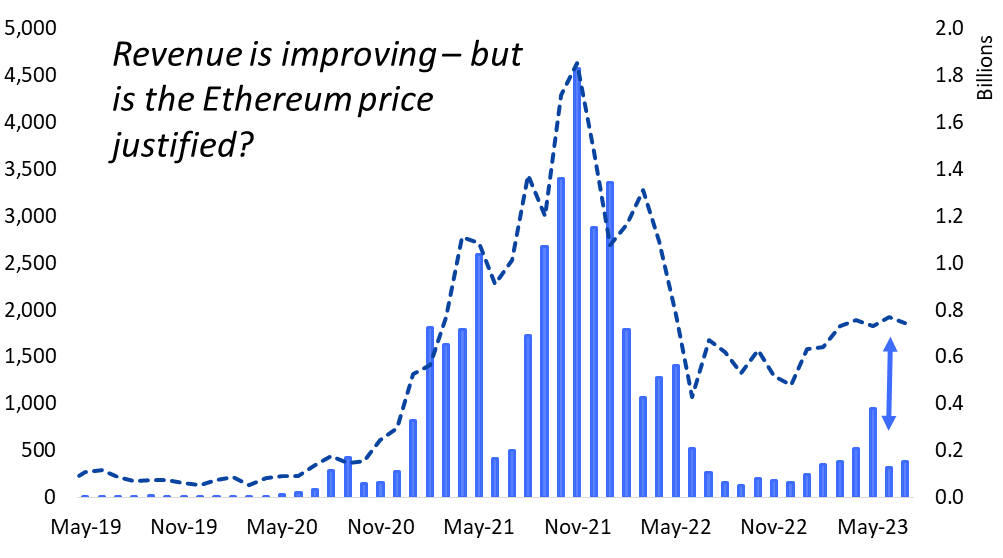
👇 3) Revenues in early 2021 were driven by the DeFi yield farming boom and during the second half of 2021 by the NFT minting craze. Today, both ‘drivers’ are nearly non-existent – compared to the significant revenue generators of 2021.
👇 4) Ethereum’s lackluster trading ranges directly result from less engagement, and the upgrades are just too slow, nor are they significant game changers - at this point. Hence, revenues are down -49% from 2022 and -78% from 2021.
👇 5) Since April 2023, TVL has also stalled again. Rising from $58.6m in early 2023 to a peak of $73bn this year and now having retraced back to $64bn. Notably, TVL from decentralized exchanges (DEX) has declined by $6.7bn while staking was able to add another $2bn. This brings the staking sector to a year-to-date increase of $9.1bn. The only game in town…
👇 6) DEXs still hold $20bn in TVL but staking is likely to continue to add to its $15.4bn on tokens tied up, especially after the Curve Finance issues from the day before.
👇 7) Interesting to note that Ethereum staking rewards (validator as a service: 4.98% yield) are now below US interest rates (5.25/5.50%). Is staking ETH worth the risk?
👇 8) Contrary to the multiple expansion for US tech stocks, crypto prices remain closely linked to the underlying fundamental drivers.
👇 9) An at-the-money put for the December 2023 expiry put appears to trade at the same implied volatility for Ethereum as for Bitcoin (both near 42%), while historically, Ethereum’s implied vol has only on brief occasions dropped below Bitcoin’s.
👇 10) Buying a put on Ethereum and financing it by selling one on Bitcoin appears to be a zero-cost (but not zero-risk) strategy. It makes sense when Ether appears overvalued based on revenue-generating capabilities.
🚩Learn about the 2020/21 DeFi bull market and the 2022 Crypto bankruptcies in "Crypto Titans: How trillions were made and billions lost in the cryptocurrency markets". Available on Amazon (and other places): (https://amzn.to/3K14sLH)
Regression analysis: Ether vs. Ethereum’s Revenue

Discussion about this post