
Why this report matters
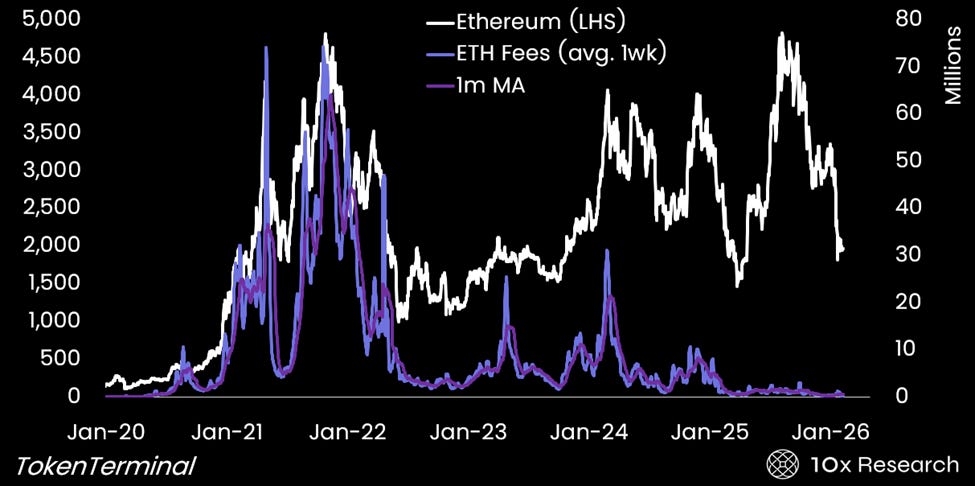
Bitmine shareholders have now endured approximately $8.8 billion in paper losses, a figure that surpasses the roughly $8.0 billion in losses initially suffered by FTX customers when the exchange collapsed. Bitmine’s aggressive accumulation of Ethereum comes at a time when demand appears subdued, with ETH trading near levels first seen in April 2021. In contrast, FTX’s prior $1.4 billion investment in Anthropic, made using customer funds, would be worth roughly $30 billion today had it not been sold for $1.3 billion in March and May 2024 during bankruptcy proceedings.
At the time of that sale, OpenAI was already valued at nearly $80 billion with $3.7 billion in annual revenue, while Anthropic generated approximately $1.0 billion in revenue in 2024, suggesting the exit price arguably undervalued the asset. Today, Anthropic’s valuation reportedly stands near $380 billion, compared to Ethereum’s market capitalization of roughly $227 billion. The contrast illustrates how dramatically capital allocation outcomes can diverge, and how quickly narratives can reverse when timing and governance decisions determine who ultimately benefits from long-term value creation.
Ethereum is now trading at valuation and cost-basis levels where its fundamental value proposition is being structurally tested. Investors must therefore assess carefully whether the asset is simply in a cyclical downturn or entering a phase of deeper structural impairment.
Ethereum (LHS) vs. ETH Fees (RHS, $ millions)