
Why this report matters
Strategy’s STRC issuance program has quickly evolved from a niche funding tool into one of the most important marginal drivers of its Bitcoin accumulation strategy. While much of the market focuses on the headline issuance capacity, the more relevant question is how much capital STRC can realistically generate under actual market conditions, and what that implies for Bitcoin demand.
At a theoretical level, Strategy has created a very large funding runway. With the addition of a new $21 billion STRC at-the-market program, alongside remaining capacity from prior programs, the company has positioned itself to raise more than $20 billion through this instrument alone. However, this headline number significantly overstates what is realistically achievable. STRC issuance is not constrained by legal capacity but by market acceptance, and more specifically by whether the instrument can consistently trade close enough to its $100 stated value to remain financeable.
In this report, we answer: How much capital can Strategy realistically raise through STRC, and how much of that translates into Bitcoin demand? What are the real constraints behind this strategy, and why is the $20B+ headline capacity misleading? Can Strategy truly move the Bitcoin market, or is its impact more marginal than most investors believe? Why might STRC fail exactly when Bitcoin needs support the most? We use our proprietary 10x STRC Funding Stress Indicator to identify when STRC issuance is likely to accelerate, and when the funding engine is at risk of stalling.
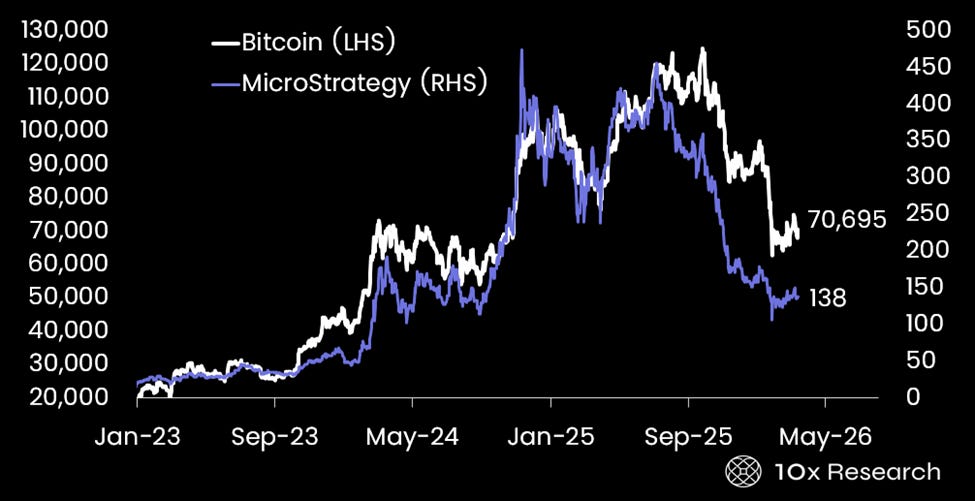
Bitcoin (LHS) vs. MicroStrategy (RHS)