
Bitcoin options trading is one of the most frequently requested topics among our subscribers. This report is our response, a complete framework, built from the ground up, covering every rule that separates consistently profitable options traders from the majority who blow up.
For subscribers who want to go deeper, Trading Signals publishes the 10x Volatility Edge weekly, a dedicated options report that applies these rules to live market conditions, identifying exactly which environment you’re trading in. This document is available to all subscribers, downloadable and printable, with charts separated at the end for easy reference.
One important clarification on a widely-cited statistic: studies show that 75–80% of options held to expiration expire worthless. That does not mean options traders lose money most of the time. It means undisciplined traders do. The traders on the right side of that statistic are not smarter or luckier; they follow the rules.
Not because the instrument is too complex, but because they trade it without a framework. Bitcoin options interest is surging, and with good reason. Since the ETF approvals, options volumes have outpaced spot trading growth, drawing in a new wave of traders who are underprepared for the instrument.
When I began my career as an index options trader at Morgan Stanley, the framework below was drilled into me from day one. The Greeks, the surface, the discipline around sizing and rolls. Adjusted for Bitcoin’s unique dynamics, that framework has held up. These 23 rules are what separate consistently profitable options traders from the majority who constantly lose money.
• Rules 1–10 build the foundation: implied volatility, term structure, skew, theta, delta, spreads, liquidity, implied volatility crush, sizing, and rolling.
• Rules 11–16 cover the market mechanics, gamma, quarterly expiries, and how dealer hedging creates mechanical price pressure in spot. Miss this layer and the market will move against you in ways that feel random but aren’t.
• Rules 17–23 are the edge layer: where the money is made and lost, how to read the full volatility surface, the realized vs. implied spread, and why averaging down on a losing option is nothing like averaging down on spot.
Trading Signals subscribers get the full 23-rule playbook plus the 10x Volatility Edge, updated weekly to identify exactly which environment you’re trading in.
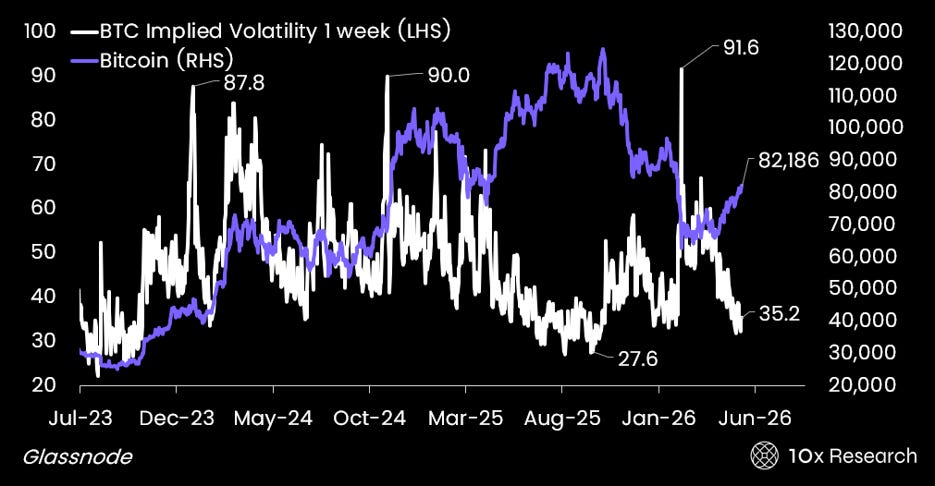
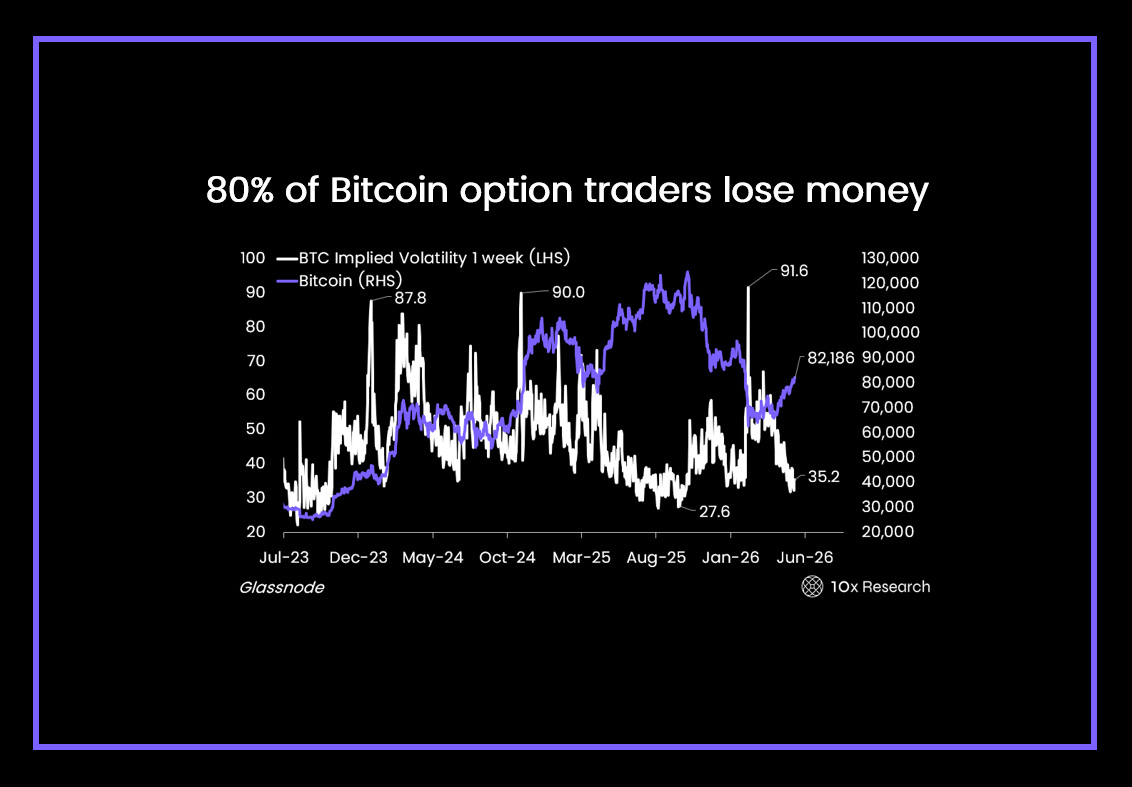
Bitcoin Short-Term Implied Volatility (LHS) vs. Bitcoin (RHS)